
This post contains affiliate links. As an Amazon Associate, I earn from qualifying purchases. This means I may earn a commission if you click through and make a purchase, at no extra cost to you. Here’s how it works.
Children with autism can learn, communicate, explore, and develop important life skills in many different ways. However, some children may benefit from learning environments that provide additional visual, tactile, auditory, and hands-on support. Educational toys and learning items can be useful tools because they can turn everyday learning into an interactive experience that is easier for a child to understand and engage with.
The goal is not simply to keep a child entertained. A well-selected educational toy can support communication, sensory exploration, fine-motor development, visual learning, problem-solving, early academic concepts, and daily routines. Some items can also complement strategies used by parents, teachers, speech-language professionals, occupational therapists, or ABA practitioners. For example, visual schedule cards may help a child understand what happens next, while textured sensory mats may provide opportunities for safe tactile exploration.
Every autistic child is different. A toy that is calming and engaging for one child may be distracting or uncomfortable for another. Therefore, educational toys should be selected according to the child’s age, developmental level, communication style, sensory preferences, interests, and individual goals. They should complement—not replace—professional guidance when a child receives therapy or educational support.
This guide looks at four educational, learning and sensory products that serve different purposes: the Tesion 24 Set Sensory Mats, the Aullsaty Talking Flash Cards, the Quokka Reward Chore Chart Cards, and the AugToy Montessori Wooden Puzzles and Shape Sorting Toys.
Why Are Educational Toys & Learning Items Important for Kids With Autism?
Educational toys can create a bridge between learning and play. Traditional teaching methods do not work equally well for every child, and some autistic children respond particularly well to concrete objects, pictures, repetition, movement, and hands-on activities. Toys allow parents and educators to present concepts in a more interactive way.
For example, instead of simply telling a child about different shapes, a shape-sorting toy allows the child to physically pick up a shape and place it into the appropriate opening. Similarly, rather than verbally explaining an entire daily routine, a visual schedule can show a child what activities are coming next.
Supporting Sensory Exploration
Sensory processing is an important consideration for many autistic children. Some children actively seek certain sensations, while others may find particular sounds, textures, movements, lights, or touches overwhelming. Sensory-oriented educational items can provide structured opportunities for exploration.
Textured mats, for example, can introduce different tactile sensations through a controlled activity. A child may touch, walk across, or explore the different surfaces depending on the product’s design and the child’s abilities.
The purpose should not be to force a child to experience an uncomfortable sensation. Instead, parents and educators can observe the child’s responses and allow the child to interact with sensory materials at a comfortable pace.
Supporting Visual Learning and Daily Routines
Many children benefit from visual information because pictures and symbols can make abstract instructions more concrete. A visual routine can show the sequence of activities such as waking up, getting dressed, eating breakfast, going to school, playing, and preparing for bed.
Visual schedules can also be useful alongside structured educational approaches, including ABA-based programs where appropriate. A child may find it easier to understand “first this, then that” when the information is represented visually rather than communicated entirely through spoken instructions.
A reward or chore chart can take this idea one step further by helping children understand expectations and recognize progress. However, reward systems should be individualized and used positively rather than as a source of pressure.
Encouraging Speech and Communication
Communication can look different for every autistic child. Some children communicate verbally, while others may use gestures, pictures, communication devices, or a combination of methods. Educational toys that introduce vocabulary can provide opportunities for practicing words and identifying objects.
Talking flash cards can be particularly useful for children who enjoy auditory feedback. A child can see an image, hear a corresponding word, and repeat it if they are able and interested. Parents can also use the cards as conversation starters rather than focusing only on memorization.
It is important to remember that speech development should be individualized. A talking toy can support practice and exposure, but it should not be considered a substitute for professional speech-language support when such support is needed.
Developing Fine-Motor and Cognitive Skills
Puzzles, sorting games, and manipulatives can help children practice skills such as grasping, matching, categorizing, recognizing shapes, and solving simple problems.
These activities can also encourage concentration and persistence. When a child successfully completes a puzzle or sorts several pieces correctly, they experience a clear connection between action and result.
The activity can be adjusted according to the child’s ability. Parents can begin with a few simple pieces and gradually introduce more challenging tasks as the child becomes comfortable.
Four Educational Toys and Learning Items for Kids with Autism
1. Tesion 24 Set Sensory Mats: Textured Sensory Floor Tiles and Wall Panels
The Tesion 24 Set Sensory Mats (affiliate link) is designed around tactile exploration. The set includes assorted textured sensory pieces that can be used as floor tiles or incorporated into sensory-learning spaces, depending on the particular setup and the child’s needs.
The biggest attraction of this type of sensory product is variety. Instead of exposing a child to just one texture, a collection of different surfaces gives children opportunities to explore how materials feel. This can make sensory play more interesting while providing parents and educators with different ways to structure activities.
For an autistic child who enjoys tactile exploration, sensory mats can become part of a play area, classroom activity, or sensory corner. A parent or teacher might encourage the child to touch different surfaces, identify differences, or move between selected mats.

- Value Pack: This set includes 24 sensory mats, each with a different texture or material that can stimulate and engage t…
- Variety of Tactile Surfaces: These sensory tiles feature 24 unique textures and materials, which can stimulate children’…
- Ideal for Sensory Play and Therapy: These autism sensory toys are an excellent choice for individuals with sensory proce…
(affiliate link)
Key Features:
- Value Pack: This set includes 24 sensory mats, each with a different texture or material that can stimulate and engage the sense of touch. These sensory mats for autistic children are easy to store, stack, and move, which makes them ideal for both at-home and classroom environments.
- Variety of Tactile Surfaces: These sensory tiles feature 24 unique textures and materials, which can stimulate children’s sensory exploration and help them better understand the world around them. From soft and fluffy to rough and bumpy, every sensory floor tiles offers a unique sensory experience that helps improve sensory awareness, fine motor skills, and cognitive development. The diverse materials also include smooth, bumpy, grooved, PU leather, imitation grass, and soft fleece-like textures, among others.
- Ideal for Sensory Play and Therapy: These autism sensory toys are an excellent choice for individuals with sensory processing disorders (SPD), autism, ADHD, or other developmental challenges. The sensory floor tiles for kids can help improve sensory tolerance, enhance focus, and aid in calming the nervous system through tactile stimulation. The different textures also encourage mindfulness and relaxation as individuals engage with each surface.
- Easy to Arrange and Store: The sensory squares can be laid out side by side to form a larger sensory pathway or be used individually for targeted sensory exercises. The top is designed with a metal ring design for easy hanging, perfect for setting up a sensory wall. The non-slip backing ensures stability, allowing your child to play safely without slipping. When not in use, the sensory pads are lightweight and easy to store, either stacked to save space.
- Versatile Use in Home, Classroom, or Therapy Settings: Whether you’re at home, in a classroom, or a therapy center, these sensory tiles for kids are perfect for use in a variety of settings. Use them as sensory pathways, for foot massage, or for fine motor activities such as sorting, matching, and identifying textures. The sensory pads for floor can also be used for fun games or obstacle courses, helping users develop coordination and balance.
- 24-piece sensory set: The multiple pieces provide a variety of options for creating sensory activities.
- Different textures: Assorted surfaces can encourage tactile exploration.
- Flexible educational use: The pieces may be incorporated into sensory play, classroom activities, or a dedicated sensory area.
- Floor and wall possibilities: Depending on the setup and manufacturer’s intended use, textured panels can be incorporated into different learning environments.
- Useful for hands-on learning: Children can learn through touch rather than relying entirely on verbal explanations.
- Suitable for sensory-focused activities: The mats can become part of an individualized sensory routine.
Why It May Be Useful for Autistic Children:
Children who seek tactile experiences may appreciate having different textures available in a controlled environment. Educators can also use the pieces for simple activities such as matching textures, describing how surfaces feel, or following a movement path.
The mats should always be used with appropriate supervision. Parents should also check the manufacturer’s age recommendations, attachment instructions, and safety information before using the pieces as intended.
Customer Reviews:
- The 24 Set Sensory Mats has generally been well received as a versatile tactile activity for toddlers, autistic children, and kids who enjoy exploring different textures. The assortment provides plenty of variety, with each mat offering a different surface to touch, feel, or step on. Many users find the set useful not only for sensory play but also for classrooms, playrooms, therapy spaces, and sensory corners. The mats can be arranged into a sensory pathway or used individually for hands-on exploration, making the large 24-piece set feel practical for different activities.
What Users Like:
- One of the biggest things users like is the wide variety of textures.
- Children can compare soft, rough, smooth, bumpy, grooved, and fabric-like surfaces, which makes the activity more interesting than a traditional play mat.
- Parents and educators also appreciate that the pieces are relatively easy to move, arrange, stack, and store.
- The hanging rings are another useful feature when the mats are being used as part of a sensory wall or classroom display.
- Users also like that the mats can encourage children to explore with both their hands and feet while practicing texture recognition, coordination, and sensory awareness.
What Users Dislike:
- There are a few things that some users may find less convenient. With 24 individual pieces, keeping the set organized can take some effort, especially when children use the mats frequently. Some textures may also be more appealing to certain children than others, since sensory preferences can vary considerably.
- The individual tiles are designed for tactile exploration rather than providing the cushioning of a thick conventional floor mat, so expectations about floor comfort should be realistic.
- Parents and educators should also supervise younger children and check the pieces regularly for wear, particularly when they are being stepped on or handled frequently.
Final Verdict:
- Overall, the 24 Set Sensory Mats (affiliate link) can be a useful addition to a home sensory area, classroom, daycare, or therapy environment. The strongest advantage is the sheer variety: 24 different pieces provide numerous opportunities for children to touch, compare, sort, arrange, and explore textures. While the set requires some organization and may not suit every child’s preferred textures, its versatility makes it a worthwhile sensory-learning option for families and educators looking for an interactive tactile activity rather than a conventional toy.
2. Aullsaty Talking Flash Cards for Toddlers 1–3
The Aullsaty Talking Flash Cards (affiliate link) are designed as an early-learning and speech-support toy. The product is advertised as including 248 sight words and is intended for toddlers and young children. It combines visual information with audio, creating a multisensory learning experience.
Flash cards have long been used for vocabulary practice, but a talking version can make the activity more interactive. The child can look at a card and hear the corresponding word, giving them an opportunity to connect an image with spoken language.
For children who respond well to repetition and auditory feedback, this type of toy may provide an engaging way to practice vocabulary. Parents can introduce a small number of cards at a time rather than presenting all the cards at once.

- 【Toddler Montessori Learning Toys】Featuring an adorable cat-shaped reader that instantly captures attention, this educat…
- 【Speech Therapy & Sensory Support】An interactive, screen-free learning tool designed to encourage language development. …
- 【Autistic-Friendly Independent Learning】Thoughtfully designed as an autistic-friendly sensory toy, it provides calming a…
(affiliate link)
Key Features:
- Toddler Montessori Learning Toys: Featuring an adorable cat-shaped reader that instantly captures attention, this educational toy includes 248 sight words across 14 themes. It perfectly expands vocabulary and enhances cognitive milestones through immersive Montessori-style autonomous play.
- Speech Therapy & Sensory Support: An interactive, screen-free learning tool designed to encourage language development. The engaging sound-and-image combination promotes independent exploration, making it an ideal choice for speech therapy sessions and toddler sensory exploration.
- Autistic-Friendly Independent Learning: Thoughtfully designed as an autistic-friendly sensory toy, it provides calming and repetitive auditory and visual feedback. It offers a wonderful, pressure-free opportunity for toddlers with special developmental needs to learn and interact at their own pace.
- User-Friendly with Standard Accent: Super easy for little hands! Just insert a card into the cute reader to hear clear words in a standard American accent, along with realistic animal and vehicle sounds. Features a 5-level volume control and a repeat button for continuous learning.
- Premium Quality & Gift: Crafted from thickened double-copper paper that resists bending, with a rechargeable battery lasting up to 5 hours. Designed for toddlers ages 1-3, this portable Montessori toy comes with a storage bag, making it a perfect birthday gift for boys and girls.
- 248 sight words: The large vocabulary collection provides many opportunities for word exposure.
- Talking function: Audio feedback can help connect visual cards with spoken words.
- Visual and auditory learning: Children receive information through more than one sensory channel.
- Designed for early learners: The product is marketed toward toddlers and young children.
- Potential speech practice: Parents can encourage children to listen, identify, repeat, or use words in simple phrases.
- Autism-friendly educational application: Its visual and auditory format may be useful for some autistic children who enjoy structured repetition.
Why It May Be Useful for Autistic Children:
The cards can be incorporated into short communication activities. For example, a parent can show a picture, allow the child to hear the word, and then ask a simple question related to the image.
The important point is to keep the activity enjoyable. If the child becomes frustrated or overwhelmed, parents can pause and return to the activity later. Children do not necessarily need to repeat every word for the activity to be valuable; listening, recognizing, pointing, matching, and attempting communication can all be meaningful steps.
If a child receives speech therapy, caregivers can also ask the speech-language professional whether this type of vocabulary activity fits the child’s communication goals.
Customer Reviews:
- Many customer reviews describe the Talking Flash Cards as a fun and interactive way for toddlers to learn new words. The set includes 248 sight words covering subjects such as animals, colors, numbers, food, vehicles, shapes, and everyday objects. Parents particularly appreciate that the cards combine pictures, spoken words, and selected sounds, making learning more engaging than traditional flash cards. Several reviewers also mention that the compact reader is easy for small children to handle and can encourage independent learning while reducing the need for screen-based entertainment.
What Users Like:
- The clear audio, colorful cards, variety of vocabulary, and simple operation are among the most frequently praised features.
- Children seem especially interested in the animal and vehicle sounds, while parents like the repeat function for practicing pronunciation.
- The rechargeable design is another convenient feature because there is no need to keep replacing batteries.
- The included storage bag also makes it easier to keep the cards organized or take them along for travel.
- Some families report that children become very attached to the toy and repeatedly return to it for independent practice.
What Users Dislike:
- The most common criticism concerns the thickness of the cards. Some parents say the cards can bend or crease when handled roughly by toddlers, which can eventually make them more difficult to insert into the reader. A few reviewers have also noticed pronunciation or sound-effect inconsistencies with particular cards, while others feel that the volume could be louder.
- There are also occasional complaints about certain illustrations or word choices being less intuitive for very young children. These issues do not appear to prevent most children from enjoying the toy, but they are worth considering if durability and precise vocabulary presentation are priorities.
Final Verdict:
- Overall, customer feedback suggests that these talking flash cards (affiliate link) are a useful and entertaining early-learning toy, particularly for toddlers who enjoy interactive sounds and visual learning. The large vocabulary selection, rechargeable reader, colorful cards, and independent-use design make it appealing for everyday learning, speech practice, and quiet play. While the cards could be sturdier and a few sounds or word presentations may not be perfect, most reviewers consider the educational value and child engagement to be strong for the price. For families looking for a simple screen-free tool to encourage vocabulary development and word recognition, this set is generally viewed as a worthwhile choice.
3. Quokka 95 Reward Chore Chart Cards for Multiple Kids
The Quokka 95 Reward Chore Chart Cards (affiliate link) are designed around visual routines, chores, responsibilities, and positive reinforcement. The product is marketed as an autism visual schedule and includes a large collection of cards intended to help organize activities.
Visual organization can be particularly useful when a child has difficulty understanding verbal instructions or transitions between activities. A visual chart can provide a predictable sequence that the child can refer to throughout the day.
For example, a parent could create a simple morning routine using cards representing getting dressed, brushing teeth, eating breakfast, and preparing for school. The child can see what comes next instead of having to remember a long verbal list.
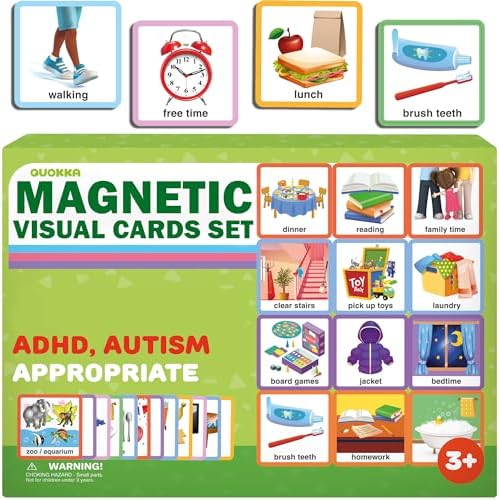
- 95 MAGNETIC TASK CARDS: Includes 80 illustrated activity cards and 15 functional cards for chores, self-care, hobbies, s…
- VISUAL DAILY PLANNER: Arrange morning, after-school, bedtime, and weekly routines on a refrigerator or other magnetic su…
- EASY TO ORGANIZE: Large text, color-coded categories, laminated cardboard, and rounded edges make the cards easy to sort…
(affiliate link)
Key Features:
- 95 MAGNETIC TASK CARDS: Includes 80 illustrated activity cards and 15 functional cards for chores, self-care, hobbies, study time, meals, and special events.
- VISUAL DAILY PLANNER: Arrange morning, after-school, bedtime, and weekly routines on a refrigerator or other magnetic surface.
- EASY TO ORGANIZE: Large text, color-coded categories, laminated cardboard, and rounded edges make the cards easy to sort and reuse.
- FOR HOME AND CLASSROOM: Helps families and teachers organize daily tasks, schedules, and responsibilities.
- CUSTOMIZABLE ROUTINES: Includes blank cards for personalized activities and tasks. Recommended for ages 3 and up.
- 95 cards: The large selection provides flexibility for different routines and activities.
- Visual schedule concept: Pictures can make daily expectations easier to understand.
- Chore support: Cards can help introduce age-appropriate responsibilities.
- Reward-chart application: Parents can use the system to recognize completed activities.
- Useful for multiple children: The product is designed for households or settings involving more than one child.
- Potential ABA-support application: Visual cards can complement structured routines and reinforcement strategies when used appropriately within an individualized program.
Why It May Be Useful for Autistic Children:
Transitions can sometimes be challenging for autistic children. A visual sequence can help communicate that one activity is ending and another is beginning.
For example, a parent might use a “First—Then” approach: first complete a simple routine, then move to a preferred activity. The chart can make the sequence visible and predictable.
Parents should avoid turning the chart into a rigid source of pressure. Flexibility is important because schedules sometimes change. Children can also be involved in selecting or arranging cards, giving them a greater sense of participation in their own routines.
Customer Reviews:
- The QUOKKA 95 Reward Chore Chart Cards are designed to make daily routines, chores, and responsibilities easier for children to understand through visual reminders. The colorful cards and magnetic format can be especially useful for families who prefer a structured routine rather than repeatedly giving verbal instructions. With cards covering different activities, rewards, reminders, and customizable tasks, the set offers plenty of flexibility for use with multiple children. Some families have found that having the routine displayed where children can see it helps them stay focused and makes transitions between activities more predictable.
What Users Like:
- One of the biggest things users like is the large selection of cards and the clear illustrations.
- Parents appreciate being able to create different schedules for individual children and adjust the routine as needed.
- The magnetic cards are also convenient because they can be moved around as tasks are completed, making the chart feel interactive rather than simply being a list of chores.
- Users have reported that the visual format can help children who respond well to pictures and routines stay on track, while the reward aspect can provide extra motivation to complete everyday responsibilities.
- The durable, laminated construction is another useful feature for something that gets handled frequently.
What Users Dislike:
- There are a few drawbacks worth considering. The number of cards can feel overwhelming at first, particularly for younger children, and the smaller pieces may be easy to misplace if they are not stored carefully. Another important concern reported by customers is language: several recent reviews on Walmart specifically complained that their cards arrived in German despite expecting English, so buyers should carefully verify the language version before ordering.
- The chart also works best when adults take some time to introduce the system and choose only the cards that are relevant rather than putting everything out at once.
Final Verdict:
- Overall, the QUOKKA 95 Reward Chore Chart Cards (affiliate link) can be a helpful organizational tool for families looking for a visual way to introduce chores, routines, and positive reinforcement. The variety of cards, colorful visuals, and reusable magnetic design are its strongest points, while the potentially confusing number of pieces and reported language-version issues are the main things to watch for. For children who respond well to visual schedules, it can be a practical addition to a home routine, but parents should confirm the card language and simplify the setup according to the child’s age and needs before using the full set.
4. AugToy Montessori Wooden Puzzles and Shape Sorting Toys
The AugToy Montessori Toys are (affiliate link) designed for early childhood learning and combine wooden puzzles, shape sorting, and hands-on problem-solving. The product is marketed for children aged 2 years and older and is designed around Montessori-style learning concepts.
Shape sorting and puzzles can be valuable educational activities because they require children to observe, compare, manipulate, and solve problems. Rather than simply receiving an answer, the child interacts with the pieces and discovers how they fit.
For autistic children who enjoy structured activities, a puzzle can provide a clear beginning, middle, and end. The child has a specific task to complete and can see the result when the pieces are correctly placed.

- ✿Montessori Toys for 2 Years Old Children: The wooden toys include flower, square, circle, triangle, star and hexagon pu…
- ✿Preschool Learning Toys: These toddler toys will challenge young minds. The open ended toys puzzle helps to develop kid…
- ✿Puzzles for Toddlers 1-3: Wooden puzzles have smooth edges, solid, bright colors, made stacking toys more likely to cat…
(affiliate link)
Key Features:
- Montessori Toys for 2 Years Old Children: The wooden toys include flower, square, circle, triangle, star and hexagon puzzles, each shape blocks coming with a board. Great cause and effect toys for kids to identify different shape puzzles, colors and sizes of the puzzle blocks.
- Preschool Learning Toys: These toddler toys will challenge young minds. The open ended toys puzzle helps to develop kid’s fine motor skills, hand eye coordination, and discovery skills. Preschool sensory toys for toddlers 1-3 years old, educational learning toys for 2 years old, sensory toys for 2+ years old, autism sensory products, problem solving toys toddler.
- Puzzles for Toddlers 1-3: Wooden puzzles have smooth edges, solid, bright colors, made stacking toys more likely to catch children’s eyes, enjoy the game, recognize and remember geometric shapes. Perfect birthday gift for boys girls age 1, 2, 3, and 4, toddler learning toys ages 1-2 years old. Toddler, puzzles for toddlers 1-3, toys for 2 years old girls.
- Kids Sorting Toys: Toddlers could combine different shape blocks together, they will obtain a sense of accomplishment quickly during the happy toddler activities play time. Also a sensory toys for those autistic children and occupational therapy toys for 12-18 months babies, montessori toys for 18-24 months old, kids sensory toy, toddler wooden toys.
- Group Play Game : The fine motor skill toys shape sorter comes with 6 pieces wooden puzzle board and 30 pieces shape set, can be played by more than one child at the same time. Great for parent-child’s interaction or preschool learning activities. Great Montessori toys for 1 , 2 and 3 + years toddler. Also perfect dementia games and alzheimers toys activities for olders. It’s also a great gifts & present for 1 ,2 , 3, 4, and 5+ years old boys girls in daily life, party, and birthday.
- Wooden construction: The toy uses a traditional wooden-learning-toy format.
- Shape sorting: Children can practice identifying and matching different shapes.
- Puzzle activities: Puzzles encourage visual discrimination and problem-solving.
- Montessori-inspired approach: The activities emphasize hands-on exploration and independent learning.
- Early-learning focus: The toy is marketed for preschool-aged children and younger learners.
- Fine-motor practice: Picking up, positioning, and manipulating pieces can exercise hand coordination.
- Suitable for boys and girls: The product is designed as a general early-learning toy rather than being gender-specific.
Why It May Be Useful for Autistic Children:
Shape sorting can support several foundational learning skills at once. A child needs to recognize a shape, determine where it belongs, grasp the piece, orient it correctly, and place it into the appropriate space.
Parents can also expand the activity beyond simply completing the puzzle. They might ask the child to identify colors or shapes, count pieces, compare sizes, or select a particular piece.
The level of difficulty should be appropriate for the child. A puzzle that is too difficult can cause unnecessary frustration, while a very easy activity may not provide enough challenge. Starting with achievable tasks and gradually increasing complexity can make learning more positive.
Customer Reviews:
- The AugToy Montessori Toys for 2+ Year Old Children are designed to combine hands-on play with early learning. The wooden puzzle and shape-sorting activities give toddlers opportunities to practice matching, identifying shapes, and developing hand-eye coordination. The simple design makes it suitable for independent play as well as parent-guided activities, while the variety of pieces can help keep young children interested.
What Users Like:
- One of the biggest advantages of this type of Montessori toy is its educational value.
- Parents may appreciate that children can practice problem-solving, colour and shape recognition, fine-motor skills, and concentration while playing.
- The wooden construction also gives the toy a more traditional feel compared with electronic learning toys. Its broad age range makes it potentially useful for toddlers and preschoolers as their abilities develop.
What Users Dislike:
- There are a few possible drawbacks to consider. Younger toddlers may need supervision and some assistance at first, particularly when learning how the different pieces fit together. Children who prefer highly interactive or electronic toys may find the activities somewhat simple.
- The number and size of the individual pieces also mean that keeping everything together after playtime can require some organization.
Final Verdict:
- Overall, the AugToy Montessori wooden puzzle and shape-sorting set (affiliate link) can be a useful choice for families looking for screen-free educational play. Its focus on matching, sorting, coordination, and problem-solving makes it suitable for early-learning activities at home or in a preschool setting. It is best viewed as a hands-on learning toy rather than a highly advanced sensory product, and its usefulness will depend on the child’s age, interests, and developmental stage.
Which Educational Toy Should You Buy for Which Purpose?
Choose Tesion Sensory Mats for Tactile and Sensory Exploration
- If your primary goal is to give a child opportunities for tactile exploration, the Tesion 24 Set Sensory Mats (affiliate link) may be the most appropriate choice among these four products. The variety of textures makes it possible to create different sensory activities instead of relying on one type of material. It may be particularly interesting for children who seek hands-on experiences. However, sensory preferences differ considerably, so parents should observe whether their child enjoys or avoids particular textures.
Choose Aullsaty Talking Flash Cards for Vocabulary and Speech Practice
- The Aullsaty Talking Flash Cards (affiliate link) are the most suitable option when the main focus is early vocabulary, listening, and speech-related practice. The combination of pictures and spoken words can provide an additional way to introduce vocabulary. Parents can use the cards during short learning sessions and encourage children to point, identify, listen, imitate, or use words naturally. For children with significant communication needs, the toy should be viewed as a supplementary learning resource rather than a replacement for professional communication support.
Choose Quokka Reward Chore Chart Cards for Visual Routines and Daily Activities
- For children who benefit from predictable routines and visual information, the Quokka 95 Reward Chore Chart Cards (affiliate link) may be the strongest choice. These cards can help break a complicated routine into smaller, understandable steps. They may be particularly useful for morning routines, chores, transitions, classroom activities, and positive reinforcement. Families using structured approaches such as ABA can discuss with their practitioner how visual schedules and reinforcement tools can fit into an individualized plan.
Choose AugToy Montessori Toys for Puzzles, Sorting, and Fine-Motor Learning
- The AugToy Montessori Wooden Puzzles and Shape Sorting Toys (affiliate link) are the most appropriate choice when the main goal is hands-on cognitive learning. They can encourage shape recognition, matching, problem-solving, visual discrimination, and fine-motor coordination. They are a good option for children who enjoy puzzles and structured manipulation activities. Parents can make the toy more educational by adding simple questions about colors, shapes, sizes, and numbers while allowing the child to work at their own pace.
How to Use Educational Toys & Learning Items Effectively
Buying an educational toy is only the first step. How the toy is introduced can make a significant difference in whether the child finds the activity enjoyable and useful.
Start with the child’s interests. If a child loves touching different surfaces, a sensory mat may naturally attract their attention. If another child loves sounds and pictures, talking cards may be more appealing. Following the child’s interests can make learning feel less like a demand and more like play.
Keep activities short when necessary. A child does not need to sit with a toy for an extended period for it to have educational value. Several short sessions may be more successful than one long session.
Use repetition. Many children benefit from practicing the same skill multiple times. A parent might use the same few flash cards each day until the child becomes familiar with them before introducing new vocabulary.
Follow the child’s sensory signals. If a texture causes distress, do not force interaction with it. If a sound is unpleasant, lower the volume or discontinue the activity. Sensory learning should be supportive rather than overwhelming.
Give children opportunities to lead. Allowing a child to choose a puzzle, select a flash card, or decide which sensory mat to explore can increase engagement and encourage independence.
Most importantly, remember that the purpose of educational toys is not to make every child behave or learn in exactly the same way. The purpose is to provide tools that make learning, communication, exploration, and everyday activities more accessible.
Safety and Selection Considerations
Parents should always check the manufacturer’s recommended age range and safety instructions before giving an educational toy to a child. This is particularly important for products containing small pieces, detachable components, cords, electronic parts, or materials that could present a choking or other safety risk.
Sensory products should also be inspected regularly for damage or loose components. Wooden puzzles should be checked for splinters or broken pieces, while electronic toys should be used according to the manufacturer’s instructions.
Parents should consider developmental ability rather than relying exclusively on chronological age. Two children of the same age can have very different abilities and sensory preferences.
For children receiving occupational therapy, speech therapy, ABA-based services, or other educational interventions, caregivers can discuss new toys with the relevant professional. A therapist may be able to suggest specific ways to use a toy to support an existing goal.
Conclusion
Educational toys and learning items can be valuable additions to the everyday learning environment of an autistic child. Sensory mats can provide tactile exploration, talking flash cards can introduce vocabulary through visual and auditory learning, visual reward and chore cards can support routines and transitions, and Montessori-style puzzles can encourage shape recognition, problem-solving, and fine-motor skills.
There is no single “best” educational toy for every autistic child. The best choice depends on the child’s individual needs, interests, communication abilities, sensory preferences, and developmental goals. Rather than choosing a product simply because it is marketed for autism, parents should consider what specific skill they want to encourage and whether the child actually enjoys interacting with the item.
The four products discussed here serve different purposes. Tesion sensory mats are geared toward tactile exploration, Aullsaty talking cards toward vocabulary and communication practice, Quokka cards toward visual routines and positive reinforcement, and AugToy puzzles toward hands-on cognitive and fine-motor learning. Used thoughtfully and safely, educational toys can turn ordinary playtime into meaningful opportunities for exploration, communication, independence, and learning.